
The Science Behind Peppermint Oil for Scalp Health
Peppermint oil isn't just a tingle. Here's what the research actually shows about hair growth, scalp circulation, and why concentration matters more than presence.
Peppermint oil shows up in roughly half of all "scalp health" hair products on the market right now. Most of them include it for the tingle, not the benefit. Here's what the research actually shows — and what to look for when you're choosing a product that uses it.
The headline study: peppermint vs minoxidil in mice
The most cited research on peppermint oil for hair is a 2014 study published in Toxicological Research (you can find it on PubMed). Mice were divided into four groups, each receiving a different topical treatment for 4 weeks:
- Saline (control)
- Jojoba oil (carrier control)
- Minoxidil 3% (the active ingredient in Rogaine)
- Peppermint oil 3% (diluted in jojoba)
The peppermint oil group had the most hair regrowth. Not "comparable to minoxidil" — more than minoxidil, in this study, in mice, at that specific concentration.
The mechanism: peppermint oil's menthol activates blood flow to the scalp by relaxing blood vessels and stimulating circulation at the follicle level. Better blood flow means better nutrient delivery to hair roots. Better nutrient delivery means stronger hair growth.
The honest caveats
Before you go ordering bottles of pure peppermint oil:
-
Mice aren't humans. Mouse skin and human skin metabolize topicals differently. The effect is often more pronounced in mice than it translates in humans.
-
3% concentration is specific. Below 1%, you get no measurable effect. Above 5%, you get scalp irritation. The sweet spot is narrow, and most over-the-counter products don't disclose their concentration.
-
Four weeks is short-term. The study didn't follow what happens at month 3 or month 6. The mice may have plateaued — or the effect may have compounded.
-
No human studies of similar size exist. The smaller human studies that do exist generally support scalp circulation benefits, but they're underpowered to make strong growth claims.
What we can say honestly: peppermint oil at the right concentration appears to help. It's not a guarantee. It's a small advantage when stacked with other healthy-scalp habits.
What "the right concentration" actually means
Most peppermint shampoos on the market are either too weak (peppermint listed second-to-last in the ingredients, meaning <0.5%) or too aggressive (essential-oil-forward products meant for tinted bottles, not daily use).
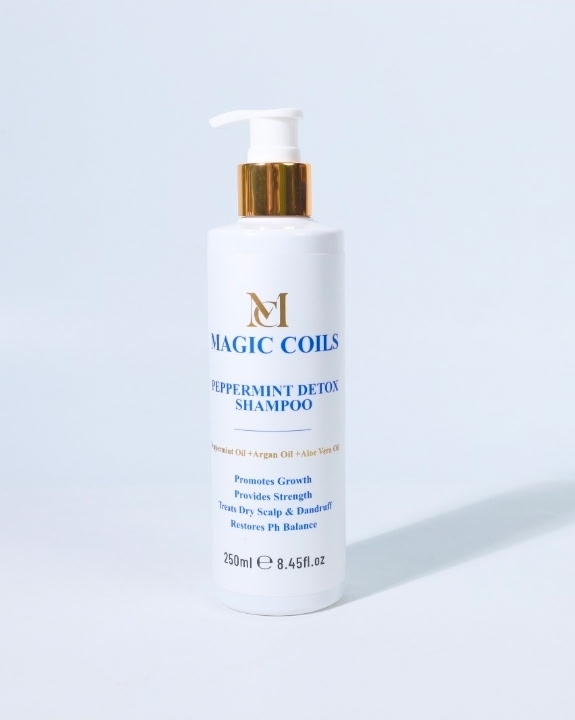
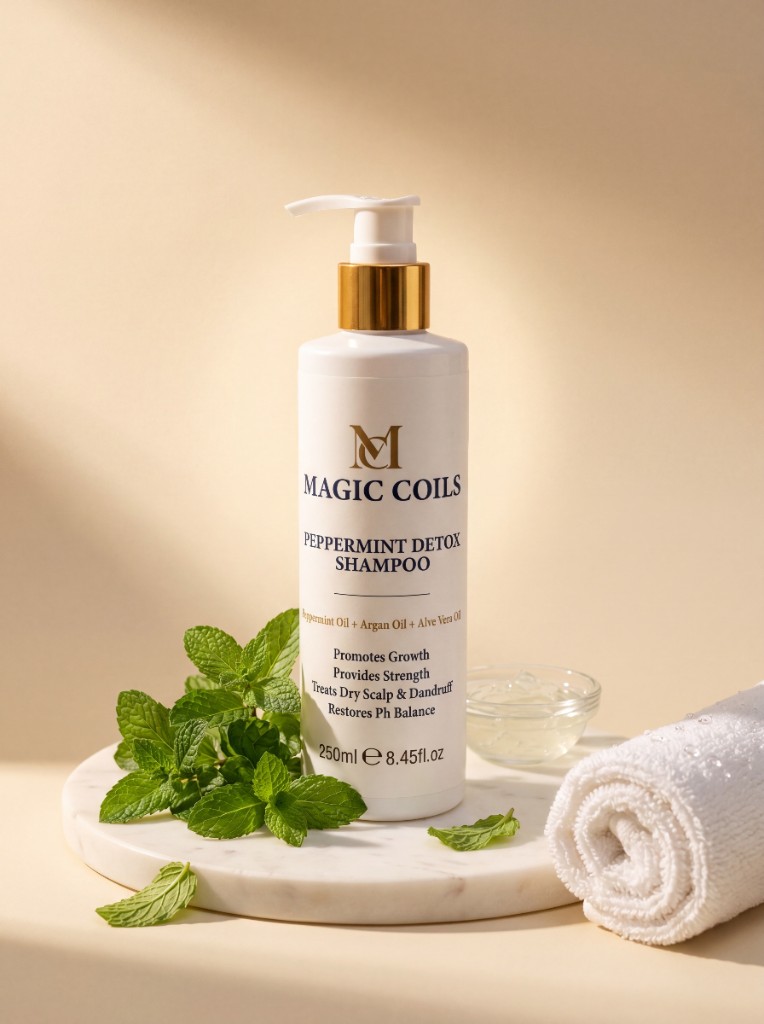
The Magic Coils Peppermint Detox Shampoo formulates peppermint oil at a tested concentration meant to deliver scalp benefits without irritation. It's paired with tea tree oil (also for scalp microbiome support) and a sulfate-light cleansing base. The combination is what makes it work for textured hair — peppermint alone in a harsh sulfate cleanser would over-strip; peppermint in a lightweight, conditioning cleanser supports without stripping.
Beyond growth: the other things peppermint oil does
Hair growth gets the headlines, but peppermint's scalp benefits go beyond that:
Itch relief. The cooling sensation from menthol genuinely calms inflammation-driven itch. If your scalp itches in the days between washes, a peppermint shampoo on wash day can stretch the comfortable interval by 1-2 days.
Dandruff reduction. Menthol has mild antifungal properties. Combined with tea tree (also antifungal), the combination addresses Malassezia yeast — the most common cause of dandruff and scalp flaking.
Buildup breakdown. Peppermint oil helps emulsify silicone and waxy product residue. If you've been heat-styling with serums or layering oil-heavy products, a peppermint wash reset is more effective than a standard cleanse.
Improved product penetration. A clean, well-circulated scalp absorbs follow-on products (conditioner, leave-ins, oils) more effectively. Peppermint at the start of your routine sets up everything that comes after to work better.
Who shouldn't use peppermint oil shampoos
A few groups should avoid or limit peppermint products:
- Pregnancy (first trimester). Limited research on essential oil exposure during early pregnancy. Most OB-GYNs recommend caution with menthol-heavy products in the first 12 weeks. After that, intermittent use is generally fine — talk to your doctor.
- Children under 6. Menthol concentrations safe for adults can over-stimulate younger skin.
- Anyone with active scalp psoriasis or eczema flares. Menthol can sting open or inflamed skin. Wait until flares are calm.
- Heat sensitivity. If you experience burning rather than tingle, dilute further or switch to a non-menthol cleanser like our Intense Hydration Shampoo.
How peppermint fits into a full routine
Peppermint oil is a scalp ingredient, not a hair-length ingredient. It works at the root and benefits the follicle — not the ends of your strands. That's why we paired the Peppermint Detox Shampoo with conditioners and leave-ins that focus on length and moisture.
In the full Magic Coils routine:
- Peppermint Detox Shampoo — handles scalp (peppermint + tea tree)
- Moisture Rich Conditioner — handles length (deep hydration)
- 3-In-1 Leave In Treatment — handles moisture lock (argan + vitamin C + honey)
- Honey & Argan Strengthening Serum — handles ends (heat protection + shine)
Each product does one specific job well. Peppermint oil is great at its job. It's not great at every job. The mistake most "all-in-one" products make is trying to do too much with one ingredient.
Practical recommendations
If you're shopping for a peppermint hair product:
- Look at where peppermint is in the ingredient list. If it's after the 10th ingredient, the concentration is probably negligible.
- Check if there's a disclosed concentration. Most brands don't disclose; we do.
- Pair it with a non-peppermint conditioner. Using peppermint shampoo + peppermint conditioner + peppermint leave-in is way too much menthol on one scalp.
- Use weekly, not daily. Even at safe concentrations, daily peppermint can over-strip.
Want to try the Magic Coils version?
Our Peppermint Detox Shampoo is formulated at a clinically-relevant peppermint concentration with tea tree backup and a sulfate-light base. It's the cleanser we recommend in our wash and go tutorial for 4c hair and the foundation of the routines the Hair Quiz builds for anyone with scalp focus or heat-styling history.
Not sure if peppermint is right for your specific situation? Reply to any of our emails — we read every message and we'll talk it through.
Sources referenced in this article include the 2014 Toxicological Research peppermint-vs-minoxidil mouse study (publicly available on PubMed). The Magic Coils Peppermint Detox Shampoo formulation was developed by Antwun Wilson based on a review of the available scalp-circulation literature combined with hands-on testing on Black textured hair specifically. Nothing in this article should be taken as medical advice; if you're experiencing significant hair loss, consult a dermatologist or trichologist.
Frequently Asked Questions
Does peppermint oil actually help hair grow?
Animal studies (mostly on mice) show peppermint oil at 3% concentration outperformed minoxidil 3% for hair regrowth over 4 weeks. Human studies are smaller and less conclusive, but consistent: peppermint oil increases scalp blood flow, which supports follicle health. It's not a miracle, but it's not snake oil either.
Can I put pure peppermint oil on my scalp?
No. Undiluted essential oils cause contact dermatitis and chemical burns on sensitive skin. Peppermint oil needs to be diluted to 1-3% in a carrier (shampoo, conditioner, or oil) before it touches skin. The Magic Coils Peppermint Detox Shampoo is formulated at a safe, effective concentration so you don't have to do the math.
Why does peppermint oil tingle on the scalp?
The tingle is menthol activating TRPM8 receptors in your skin — the same cold-sensing receptors that respond to ice. It's not a sign the product is 'working' in any specific way; it's a sign that menthol is present and active. The benefit comes from the increased blood flow that menthol triggers, not the sensation itself.
Is peppermint oil safe for color-treated hair?
Yes. Peppermint oil doesn't affect dye molecules or strip color. The Peppermint Detox Shampoo is sulfate-light specifically to be safe on color, and the peppermint itself is purely a scalp ingredient.
How often should I use a peppermint oil shampoo?
1-2 times per week for most people. Daily use of any clarifying shampoo (peppermint or otherwise) can over-strip natural oils. Alternate with a moisture-rich shampoo like Intense Hydration on the days you're not using peppermint.
Products from this routine
Find your perfect routine
Take our 60-second Hair Quiz and get a personalized product routine built for your texture and goals.
Take the Hair Quiz